
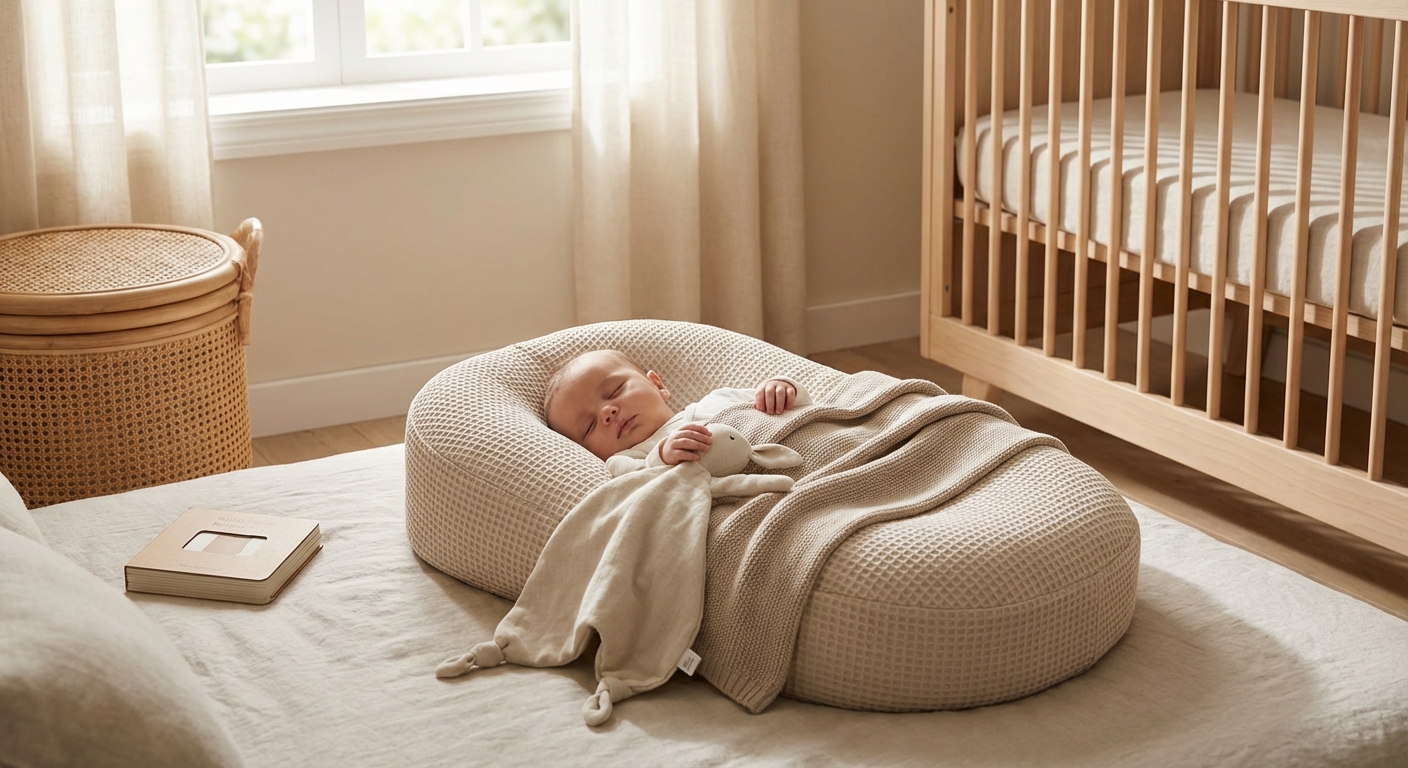
In spring, daylight lasts longer, temperatures fluctuate and the household rhythm often changes (outings, holidays, clock change). As a result, your baby’s sleep can become more fragile for a few weeks. The right approach is not to “start over”, but to choose a simple, repeatable routine suited to the season: keep familiar cues, adjust the environment, and avoid a few common pitfalls.
Why can spring disrupt your baby’s sleep?
Young children’s sleep depends a lot on external cues. In spring, several things change at once:
- More light in the evening and early morning: your baby may struggle to “understand” that night has begun, or wake at dawn.
- Unstable temperatures: the room can be too warm at the start of the night, too cool in the early morning, which favours micro-awakenings.
- Clock change (when it happens): even a one-hour shift can cause late sleep onset or early waking.
- More active family rhythm: outings late in the day, visitors, noise… your baby may go to bed over-stimulated.
Good news: in most cases, this is a temporary adjustment. A consistent routine speeds up the return to more stable sleep.
Comparison of the best spring sleep routines
There is no single “perfect” routine. The goal is to choose a routine that fits your baby (temperament, age) and your home (schedules, siblings, organisation). Here are 4 effective spring routines, with their benefits and limits.
1) “Lukewarm bath + dim lights” routine (ideal when it is warmer)
For whom? Babies who sweat, get restless at bedtime, or have trouble winding down in the evening.
- 18:30–19:30: lukewarm bath (not too hot) or quick wash.
- After: calm room, soft lights, low voices.
- Final steps: feed/baby bottle, cuddle, cue phrase (“good night, I’m here”), sleep.
Why it works: the gradual reduction in stimulation plus a lukewarm water moment helps your baby relax. In spring, this offsets the excitement of longer days.
To watch: if your baby gets excited in the bath (some do), favour a short wash and keep the calm phase afterwards.
2) “Late-afternoon outing + early dinner” routine (for babies who sleep better after fresh air)
For whom? Babies who fight sleep, or who fall asleep more easily after time outside.
- Late afternoon: short outing (balcony, garden, gentle walk).
- Return: slow down, settle into calm.
- Earlier dinner/feed to avoid over-excitation and very late sleep times.
Why it works: fresh air and natural daylight during the day help structure the biological clock. Then you “close the day” by returning to a dimmer environment.
To watch: avoid outings that are too stimulating (shopping centres, noisy visits) just before bedtime.
3) “Gradual bedtime shift” routine (useful after the clock change or for very early wakings)
For whom? Families experiencing a shift: baby falls asleep too late, or wakes too early and cannot get back to sleep.
- Shift bedtime and/or wake time in small steps (10–15 minutes) every 2–3 days.
- Keep the same steps in the routine (meal, bath/wash, cuddle, sleep).
- Expose your baby to morning light (open the curtains, a little time on the balcony) and dim the lights in the evening.
Why it works: the brain adapts better to small changes than to a big “shock”. In spring, this avoids endless evenings.
To watch: if your baby is sleep-deprived, moving too fast can increase evening crying. Better to be gradual and steady.
4) “Catch-up micro-nap” routine (when days lengthen and naps shift)
For whom? Babies who refuse the last nap or who arrive at bedtime overtired (crying, tension, agitation).
- Offer a micro-nap (10–20 min) in the late afternoon if your baby collapses.
- Otherwise, move bedtime earlier rather than insist on an impossible nap.
Why it works: overtiredness makes falling asleep harder, even if your baby seems to “hold on”. A short nap can save the evening.
To watch: if the micro-nap is too long or too late, it can delay night-time sleep. Adjust according to your baby’s reaction.
The 5 pillars of a working spring routine
- Regularity: same steps, in the same order, even if the time varies slightly.
- Light management: bright light in the morning, dimmed lighting in the evening (especially with longer days).
- Temperature and clothing: avoid overheating. Check the nape of the neck rather than hands/feet to judge if the baby is hot.
- Gentle transitions: move from play to calm gradually (no abrupt stop).
- Reassuring cues: repeated phrase, lullaby, short steady cuddle. The baby anticipates and feels safe.
According to the baby’s age: realistic expectations in spring
0–3 months: set the foundations without rigidity
At this age, the baby does not yet have a well established day/night rhythm. In spring, increased light can help gradually… provided you clearly distinguish day from night. Daytime: light, normal voice, interactions. Night: minimal light, slow movements, little stimulation.
Normal behaviours: falling asleep in your arms, frequent wakings to feed, short nocturnal awake periods. Your goal: an ultra-simple routine (change, feed, cuddle, sleep), repeated, rather than a strict fixed time.
4–6 months: stabilise and simplify
Many babies begin to link cycles better, but spring can trigger early wakings (bright dawn) or settling difficulties (over-stimulation). A 15–25 minute routine, calm and identical each evening, often makes a real difference.
Normal behaviours: temporary regressions, need for sucking, wakings related to changes in environment. Expect to adjust the late afternoon nap and protect the last hour before bedtime.
7–12 months: manage mobility and curiosity
The baby moves, stands up, experiments. With spring, they may also be more excited by outings and novelty. Here, the routine is mainly a framework: it helps the baby to "wind down" and accept separation at bedtime.
Normal behaviours: protests at bedtime, brief wakings to check your presence, naps that evolve (often 2 naps). A dark room and an earlyish bedtime are powerful allies against overtiredness.
12–24 months: the "I want" phase and lengthening bedtimes
Spring often brings more outings and sometimes a later bedtime… which the toddler may not always cope with. At this age, kind boundaries become central: short routine, limited choices (pyjamas A or B), and a clear end to the routine.
Normal behaviours: repeated requests (water, one more story), separation anxiety, early wakings if the room is bright. Keep a steady response: reassure without triggering a "second bedtime".
Common mistakes in spring (and how to avoid them without guilt)
1) Leaving the room too bright in the evening
With long days, you may realise too late that "the baby is not sleepy". Light sends a day signal to the brain, which can delay sleep onset.
Possible consequence: later sleep onset, early wakings, restlessness at bedtime. Solution: dim lights an hour before, limit screens in the room, and aim for a coherent "night" environment.
2) Over-covering the baby "just in case"
In spring it can be mild then cool. Many parents add layers for fear of cold, while the baby can quickly overheat.
Possible consequence: sweating, discomfort, frequent wakings. Solution: favour adjustable layers (easy to remove/add) and check the nape. If the baby is sweating, lighten clothing.
3) Overstimulating at the end of the day
Visits, noise, physical play and screens can "charge" the nervous system. The baby looks energetic… but this can be a sign of tiredness.
Possible consequence: evening crying, long time to fall asleep, wakings after 30–45 minutes. Solution: create a calm buffer (soft music, reading, warm light) and reserve active play for morning/afternoon.
4) Changing the whole routine at once after a bad night
After a difficult night, you may be tempted to change everything: time, naps, settling method. The problem is that the baby loses their bearings.
Possible consequence: instability over several days. Solution: change only one parameter at a time (for example, move bedtime 15 minutes earlier) and allow 3–4 days to observe.
5) Aiming for a "perfect night" instead of overall progress
In spring, wakings can be more frequent during adaptation. This does not mean you are doing something wrong.
Possible consequence: parental stress, tensions at bedtime. Solution: follow simple indicators (calmer falling asleep, less crying, shorter wakings) rather than an ideal.
How to support the baby at night without burning out
When wakings increase (heat, light, time change), the aim is to help the baby while protecting your energy.
- Prepare the night: water, diaper, muslin within reach, very low light. The less you move, the quicker your baby will fall back asleep.
- Small interventions first: pause for a few seconds, place a hand, whisper, and only then pick up if needed.
- Keep a consistent response: the same approach at each waking (reassure, calm, put back to sleep). Major variations can trigger renewed wakefulness.
- Take turns if possible: alternate night duties with the other parent when feasible, even every other night.
- Short recovery: short naps when the baby sleeps (even 20 minutes), rather than struggling all day.
FAQ – Common questions from parents in spring
My baby wakes earlier since spring, what should I do?
Early wakings are often linked to morning light. Try to keep a "night" atmosphere until the planned wake-up time: low light, minimal interactions. During the day, expose your baby to light in the morning to strengthen the day/night contrast. If bedtime is late, move it earlier gradually (10–15 minutes every 2–3 days): an overtired baby often wakes earlier.
Does evening heat stop the baby sleeping well?
Yes, thermal discomfort can cause restlessness and micro-wakings. Air the room before bedtime, dress the baby lightly and with adjustable layers, and check the nape of the neck. A soothing routine (wash or lukewarm bath) also helps. If the baby is sweating, they are likely too hot: better to remove a layer than add one.
Should I change nap times in spring?
Not necessarily, but a slight shift is common because of longer days and more activities. Watch for tired signs (yawning, rubbing eyes, staring into space, restlessness). If the last nap gets difficult, two options often work: a short catch-up nap or an earlier bedtime. The idea is to avoid evening overtiredness.
How to handle the clock change without a bedtime crisis?
The most effective method is a gradual shift: move times forward or back by 10–15 minutes in stages. Keep exactly the same routine steps. In the morning, open the curtains to let light in; in the evening, dim earlier. In a few days to two weeks, most babies adjust.
My baby cries more at bedtime since we go out more: is that normal?
Yes, a baby can be "full" of stimuli in spring (noise, new faces, travel). Crying does not necessarily mean a sleep problem: often they need help to settle down. Plan a calm buffer of 30–45 minutes before bed: no screens, gentle play, low voice, warm light. An earlier bedtime can also help.
Should I keep the routine even at weekends and during visits?
Keeping the routine steps is more important than the exact time. During visits, try to recreate 2–3 anchors: a quieter room, the same lullaby, the same cuddle, softer light. If the baby goes to bed later once, it’s not a problem; avoid it becoming the norm for several days in a row.
Is it serious if the baby falls asleep more often in arms in spring?
No. During an adaptation phase (heat, light, clock change), some babies need more closeness. The important thing is calm settling and enough sleep. When the period stabilises, you can gradually return to your habits (for example, place the baby in the crib a little earlier, with your hand on them for a few moments).
How to tell if wakings are "normal" or a sleep disorder?
Wakings are common in babies, especially during rhythm changes. They are more worrying if the baby seems very uncomfortable, if wakings come with prolonged inconsolable crying, if falling asleep is consistently very difficult despite a stable routine, or if daytime functioning is strongly affected (extreme irritability, feeding difficulties). If in doubt, speak to a health professional to rule out a medical cause (pain, reflux, ear infection, etc.).
What to do if my baby wakes sweating at night?
Start by checking the environment: ventilation, temperature, clothing. Touch the nape: if it feels hot and damp, remove a layer. Prefer breathable fabrics and avoid over-layering. There and then, change a damp bodysuit or pyjamas if needed, keep the light very low, and put the baby back to bed quickly to avoid re-awakening.
How long does it take for a new routine to work?
Generally, it takes several days to see a clear trend, often 7 to 14 days depending on age, the baby’s sensitivity and the scale of the change (times, light, temperature). If you change too many things at once, you will not know what really helps. Choose one goal (for example: earlier bedtime) and keep it long enough to observe.
Key takeaway: in spring, focus on consistency (same steps), light management (dim in the evening, bright in the morning) and thermal comfort. A simple, repeated routine is better than a complicated programme.
Comments (0)