
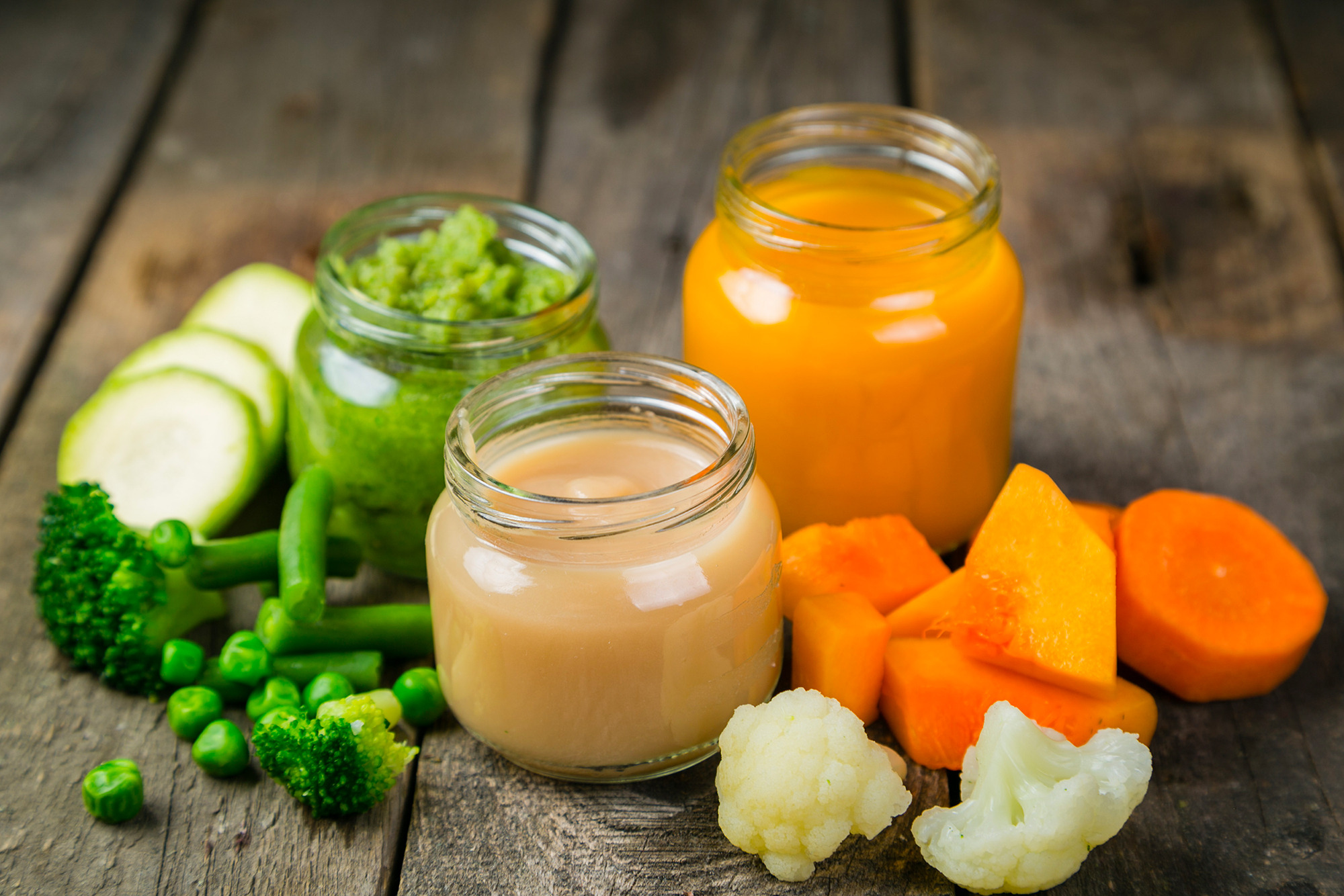
If you are about to introduce solid foods into your baby's diet, you may be feeling overwhelmed. I completely understand!
With so much information about what to give your baby and how to do it, how can you not feel a little anxious?
Let me reassure you: starting diversification alimentaire for your baby is not as hard as you might think. You are unlikely to get it wrong, rest assured. Your baby will be fine.
How do I know? Because as long as you take the necessary precautions to keep your baby safe, it is hard to make a mistake. In general, the more you trust your instinct and follow your baby's cues and expert guidance, the more you will enjoy feeding them.
When to start introducing solid foods?

Before or after 6 months?
According to UNICEF, from the first hour of life until the age of 6 months, your baby can get all the nutrients they need to grow and develop from your milk. They do not need anything else – no water, tea, juice, porridge or any other food or drink during this time.
6 months and over
When your baby reaches 6 months old, their rapid growth and development require more energy and nutrients than your milk alone can provide. They should begin to eat solid foods in addition to breastfeeding to meet their increasing needs.
Don't wait too long to start
Your baby’s body needs extra energy and nutrients to continue growing. If you wait too long, your baby may stop gaining weight at a healthy rate and become thin and weak.
Signs that your baby is ready for solid foods
Feed your baby as soon as you see feeding cues. After washing your hands with soap, start by giving your baby two or three spoonfuls of soft food with a baby spoon, such as porridge, mashed fruit or vegetables, twice a day.
Continue to breastfeed as often as before. This will help you know if your baby is already ready to eat solid foods.
What if the baby shows signs before 6 months?
If you see your baby bringing their hands to their mouth when they are under 6 months, you might think they are not getting enough nutrients from your milk. In fact, your baby is still showing normal feeding behaviour, but these behaviours are more developed now that they are older.
This does not mean your baby needs solid food straight away. Your baby is ready at 6 months, according to the World Health Organization.
How to know if your child is developmentally ready for diversification alimentaire?
You can look for the following signs that indicate your child is ready developmentally:
- Sign 1: Your child can sit with little or no support.
You can provide your baby with a high chair, safe and convenient, to help them master the sitting position more quickly. - Sign 2: Your baby begins to have good head control.
- Sign 3: They open their mouth and lean forward when shown food.
What about non-breastfed babies?
According to UNICEF, if you do not breastfeed your baby, the best time to introduce solid foods is also at 6 months.
This is the age when all babies, whether breastfed or not, should start eating solid foods to ensure they receive all the nutrition their growing bodies need.
Which foods for diversification alimentaire?
According to the American Academy of Pediatrics, for most children there is no need to give foods in a particular order.
Your child can start eating solid foods around 6 months. By 7 or 8 months they can eat a variety of foods from different food groups.
These foods include infant cereals, meat or other proteins, fruit, vegetables, yoghurts and cheeses, and so on.
If your child is eating rice cereal, it is important to offer a variety of fortified infant cereals, such as oat, barley and multigrain, rather than only rice cereal.
The US Food and Drug Administration does not recommend feeding only rice cereal to infants, as this may expose babies to arsenic.
How to prepare your baby’s first meals?
Let your baby try one food at a time at the beginning. This will help you see if your child has a problem with that food, such as a food allergy.
How long should you wait before introducing a new food to your baby?
Wait 3 to 5 days between each new food. In no time, your child will be able to eat and enjoy many new foods.
The eight most common allergenic foods are milk, eggs, fish, shellfish, tree nuts, peanuts, wheat and soy.
In general, it is not necessary to delay introducing these foods into your baby’s diet, but if you have a family history of food allergies, we recommend discussing it first with your baby’s doctor or nurse.
Food texture
At first, it is easier for your child to eat foods that are pureed or mashed and very smooth in texture.
To save time, use a robot cuiseur.
It can take time for your baby to adapt to new food textures. Your child may cough, gag or spit out food. As your baby’s oral skills develop, thicker and heavier foods can be introduced.
Are there risks?
Some foods present a choking risk, so it is important to give your baby foods with a texture appropriate for their development.
To reduce choking hazards, prepare foods that can be easily dissolved by saliva and do not require chewing.
Give small portions and encourage them to eat slowly. Always supervise your baby while they are eating.
Tips for preparing food for your baby 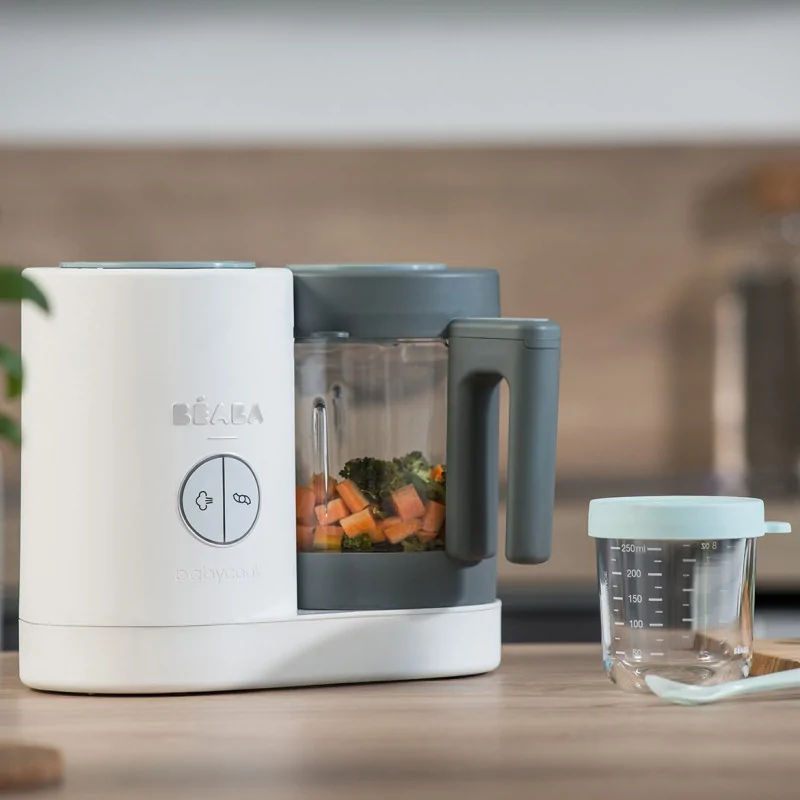
Mix pureed cooked cereals and grains with breastfeeding milk or water to make them smooth and easy for your baby to swallow.
Mash or puree vegetables, fruits and other foods until smooth; you can use the Babycook de Béaba to make this easier.
Remove all fat, skin and bones from poultry, meat and fish before cooking.
Remove seeds and hard pits from fruit, then cut into small pieces.
Cut soft foods into small pieces or thin slices.
Cut hot dogs, sausages and stringy cheeses into short, thin strips rather than round pieces that could get stuck in the airway.
Cut small round foods such as grapes, cherries, berries and tomatoes into small pieces.
Cook wheat, barley, rice and other grains and grind or mash them finely.
Myths versus REALITY
Below are some common myths about introducing solids to babies.
Of course, if you have concerns, if there are food allergies in your family or if your baby has health problems, do consult your paediatrician before starting.
Myth 1: Babies need solid food before 6 months.
Reality: Whether you breastfeed your baby or not, there is no need to start giving solids before 6 months, and it can even be harmful according to UNICEF.
Introducing foods or liquids other than breast milk into your baby’s diet before 6 months can increase the risk of illness, such as diarrhoea, which can make them thin and weak, and even put their life at risk.
Your baby may also be breastfed less often and your milk supply, their most vital food, may decrease.
Breast milk is the safest and healthiest food during the first six months of life. It provides a steady and reliable source of essential nutrition.
Myth 2: Boys need more than breast milk
Reality: Babies, girls and boys, need the same amount of food to be healthy and grow strong and smart. Your milk alone will meet the nutritional needs of a son or a daughter during the first six months of life.
Myth 3: You must start with rice cereals.
Reality: In fact, why not start with something healthy and more flavoursome? Sweet potato, avocado, squash, banana or peas.
They are all good options to begin weaning. But if you feel more comfortable starting with rice cereal, go ahead.
Myth 4: You must start between 4 and 6 months.
Reality: As we mentioned, the World Health Organization, the American Pediatric Association and most other experts recommend waiting until 6 months to start your baby on solids.
At this stage, babies are more likely to accept solid foods, less likely to develop food allergies, and can sit and swallow more easily.
Until then, no food is more nutritious than breast milk or baby formula.
Myth 5: Baby food must be bland.
Truth: While it is best to avoid salt, sugar and very spicy foods, don’t hesitate to add flavour with healthy spices and herbs.
In many parts of the world, babies eat curry for their first meal — and they love it!
Starting to expose your baby to interesting flavours can encourage acceptance of different tastes in the future.
(If you breastfeed, your baby already tastes different flavours every day depending on what you eat)
To conclude
The early stages of complementary feeding can sometimes feel worrying. But if you adopt the right habits and have the right tools, everything will be fine.
We are pleased to let you know that everything you need for your baby’s meal is available at our shop, with a single click!
Comments (1)